For most visitors, an automatic is the better choice. It's what the large majority of New Zealand rental cars are; it removes one task while you adjust to the left side of the road, and it's the one option every licence holder can use. A manual suits experienced manual drivers who want more control and may find a lower daily rate where manuals are offered, but they're less common and mostly smaller cars. At the time of writing, every car in our range is listed as an automatic, including all of our hybrids.
Most travellers pick a rental car by size and price, then discover at the counter that the gearbox matters just as much. In New Zealand it matters more than usual, because you're often learning to drive on the left, on hilly roads, in an unfamiliar car, all at once. This guide explains how automatic and manual rentals compare here, what's actually available, and how to choose, whether you book with Bubble Rentals or anywhere else.
What Rental Cars in New Zealand Usually Are
New Zealand rental fleets are mainly automatic. Published New Zealand rental guidance describes manuals as less common and often limited to smaller cars, with availability varying by company, vehicle category and travel dates.
- Larger SUVs, premium cars, hybrids and electric vehicles are usually automatic only.
- Almost all hybrid and electric rentals in New Zealand are automatic.
- Manual cars, where offered, tend to sit in the smaller, cheaper categories.
So if you're considering a manual, you're not choosing between two equally common options. You're choosing a minority option that may limit your choice of vehicle.
Every Car in Our Range Is an Automatic
At the time of writing, every car in our range is listed as an automatic, from the smallest hatchback to the eight-seat people mover. Our fuel-efficient cars are no exception.

| Body Style | Examples in Our Range | Transmission |
|---|---|---|
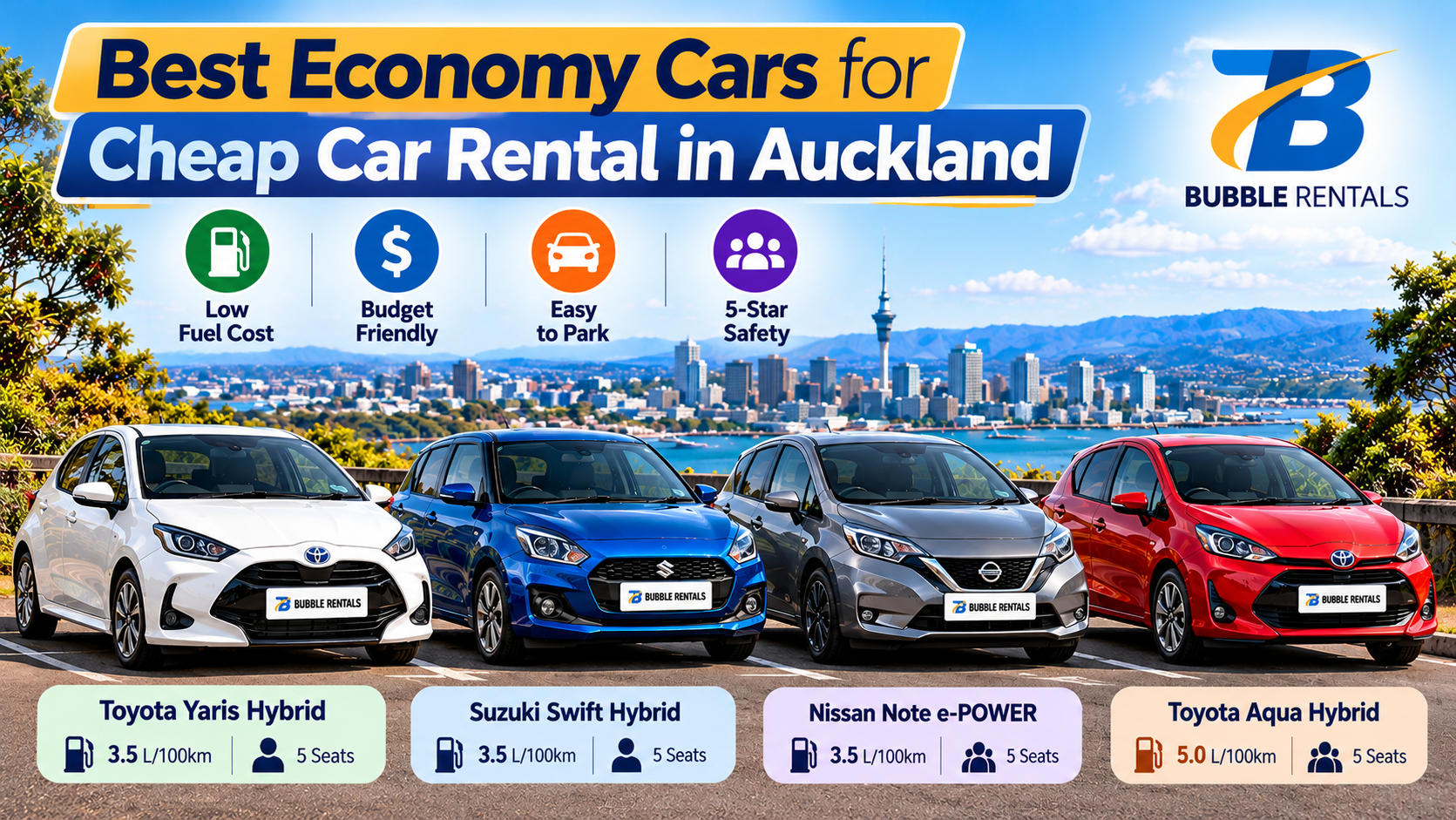
| Small hatchbacks | Nissan Note, Toyota Yaris GX, Toyota Aqua, Honda Fit Hybrid, Suzuki Swift Hybrid | Automatic |
| Mid-size cars | Toyota Corolla Hybrid hatch, sedan and Touring wagon | Automatic |
| SUVs | Toyota RAV4 Hybrid, Mitsubishi ASX, Mitsubishi Outlander (7 seats) | Automatic |
| People movers | Toyota Estima, Toyota Esquire, Nissan Serena (7 to 8 seats) | Automatic |
If a manual is essential for you, it's worth confirming with providers that list manuals, because that isn't something our current range offers.
How Automatic and Manual Cars Differ
A manual car has a clutch pedal and a gear lever, and you change gears yourself. An automatic changes gears on its own, so there's no clutch pedal and one less thing to coordinate.
- Conventional automatics use a set of gears that shift for you.
- Hybrids usually use a CVT or e-CVT, a smooth, continuous type of automatic that feels different from a conventional one but works the same way from the driver's seat.
- Pedal layout is the same either way: brake in the middle, accelerator on the right, and a clutch on the left only in a manual.
The same model can often come with either gearbox. The Toyota Yaris, for example, is sold with a manual in some markets, but the Toyota Yaris GX in our range is an automatic.
Driving a Manual on the Left: What Changes
New Zealand drives on the left, with the steering wheel on the right. In a right-hand-drive manual, you change gears with your left hand. If you normally shift with your right hand at home, that alone takes some retraining.
The pedals stay in the same order, but the rest of the picture flips. Roundabouts run clockwise, the indicator and wiper stalks are often swapped, and your sense of where the car sits in the lane is different. Our guide to driving on the left covers those adjustments.
Add a clutch and a gear lever on top of all that, and the mental load climbs. Many drivers manage it comfortably, but if you're already adapting to left-side driving, an automatic removes one variable.
Hills, Winding Roads and One-Lane Bridges
New Zealand roads put more demands on a driver than the map suggests. Steep climbs, tight bends, stop-start town traffic and one-lane bridges all call for frequent stopping and starting.

Hill Starts and Stalling
In a manual, starting on a slope means managing the clutch and the handbrake together, and a stall in front of traffic or at a one-lane bridge is stressful. Many modern automatics make this far easier, and our rural driving tips explain what to expect on the roads where stopping and starting happens most.
Long Descents
Manual drivers can choose a lower gear on a long downhill to let the engine help slow the car. Automatics offer a similar option through a low gear or engine-braking setting, and some hybrids have a B mode. If your route includes steep descents, ask at pickup how it works on your car.
Licence Rules: Why Automatic Is the Safe Choice
This is the point that decides the question for some travellers. Any condition attached to your overseas licence still applies in New Zealand. If your licence only permits automatic vehicles, that restriction remains in force while you drive here.
- A licence that allows manual driving also lets you drive an automatic.
- A licence restricted to automatic does not let you drive a manual.
- Some countries mark this on the licence itself. Japanese licences, for example, show whether you're cleared for AT (automatic) or MT (manual).
That makes an automatic the one choice that works for every full licence holder. Driving outside your licence conditions is an offence, so check yours before you book. If your licence isn't in English, you'll also need an accepted translation, and our driving permit guide explains how that works.
Cost: Is an Automatic More Expensive?
It depends, and the answer is less dramatic in New Zealand than many people expect.
- Published New Zealand rental guidance says there's often little price difference between automatic and manual cars.
- The age and category of the vehicle usually move the price more than the gearbox does.
- Where a manual is cheaper, it's typically in the smaller categories, which is also where manuals are most available.
Fuel economy follows a similar pattern. Modern automatics are close to manuals in fuel use, and the most efficient cars on the road, hybrids, are automatic by design. Our hybrid fuel savings guide explains what that means for your fuel bill.
When Manual Makes Sense
A manual is a reasonable choice for some drivers.
- You drive a manual every day and shifting is automatic for you.
- You want the control of choosing your own gear, especially on winding roads.
- You've found a manual in the category you want at a lower price.
- You're comfortable with the left-hand lever and the left-side roads, or you've already driven that way.
If that's you, a manual can be a good fit, provided you can find one for your dates.
When Automatic Makes Sense
An automatic is the better choice more often than not.
- It's your first time driving on the left.
- You've just landed after a long flight and will be tired.
- Your itinerary includes Auckland traffic, hills or lots of stop-start driving.
- You need a hybrid, an SUV or a people mover, since these are almost always automatic.
- Your licence is marked automatic only, or you aren't sure.
Quick Decision Guide

| Your Situation | Better Choice |
|---|---|
| First time driving on the left | Automatic |
| Licence is automatic only | Automatic (the only option you can use) |
| Experienced manual driver who wants control | Manual, if one is available |
| Mostly city and airport driving | Automatic |
| Winding or hilly route, little manual experience | Automatic |
| You want a hybrid, SUV or people mover | Automatic |
| Arriving after a long-haul flight | Automatic |
Choosing an Automatic by Size
Once the gearbox is settled, choose by size and use.
City Driving and Short Trips
A small automatic hybrid suits Auckland traffic well. The Toyota Aqua is a compact example, easy to park and economical in stop-start driving.
Families and Gear
For more space and a higher driving position, the RAV4 Hybrid is a five-seat SUV with 4WD. For larger groups, our range includes seven and eight-seat people movers, all automatic.
Our vehicle range shows every model with its seats and transmission.
How to Make Sure You Get the Right Gearbox
Don't assume. Confirm.
- Check the transmission shown on the listing for the exact car you're booking.
- If the provider offers both gearboxes, select yours explicitly rather than accepting a default.
- Check that your booking confirmation shows the transmission you chose.
- If your licence has any conditions, check them against the vehicle before you travel.
Our booking guide walks through the booking steps in order.
Questions to Ask Before You Book
- Is this car an automatic or a manual?
- If it's an automatic, is it a conventional gearbox or a CVT, and does it have an engine-braking setting?
- Does my licence have any conditions about transmission?
- Is there a price difference between the gearboxes for my dates?
- Can I get a quick walkthrough of the controls at pickup?
A Short Checklist
- Check whether your licence permits manual, automatic, or both.
- Decide how much you want to manage while adapting to the left side.
- Compare the total price, not just the gearbox.
- Confirm the transmission on your booking, not just the vehicle name.
- Ask for a quick walkthrough of the gear selector and any drive modes at pickup.
Frequently Asked Questions
Are rental cars in New Zealand manual or automatic?
Most are automatic. Manuals exist with some providers, but they're less common and usually smaller cars, while hybrids, SUVs and people movers are almost always automatic.
Can I rent a manual car in New Zealand?
Yes, from providers that list manuals, though availability varies by company, category and dates. At the time of writing, every car in our range is an automatic.
Is an automatic rental more expensive than a manual?
Not necessarily. Published guidance says the price difference is often small, and the age and category of the car usually matter more than the gearbox.
What if my licence says automatic only?
That condition still applies in New Zealand. You can only drive automatic vehicles, so an automatic is your only option.
Can I drive an automatic if my licence allows manual?
Yes. A licence that allows manual driving also covers automatics.
Is a manual harder to drive in New Zealand?
It can be, because you're also driving on the left, shifting with your left hand and managing hills and one-lane bridges. Experienced manual drivers often cope fine, but an automatic reduces the load.
Are hybrid rental cars automatic?
Yes. Almost all hybrid and electric rentals are automatic, and hybrids usually use a CVT or e-CVT, which behaves like a smooth automatic.
Which is better for a first-time visitor to New Zealand?
An automatic. It removes the clutch and gear changes while you adjust to left-side driving, hills and unfamiliar roads.
Can I choose a manual if I'm confident driving on the left?
If you're a confident manual driver, a manual can work well. Confirm availability with a provider that lists manuals, since options are more limited.
Ready to pick your car? Browse the options for Auckland Airport pickup, and our FAQs cover anything this guide didn't.