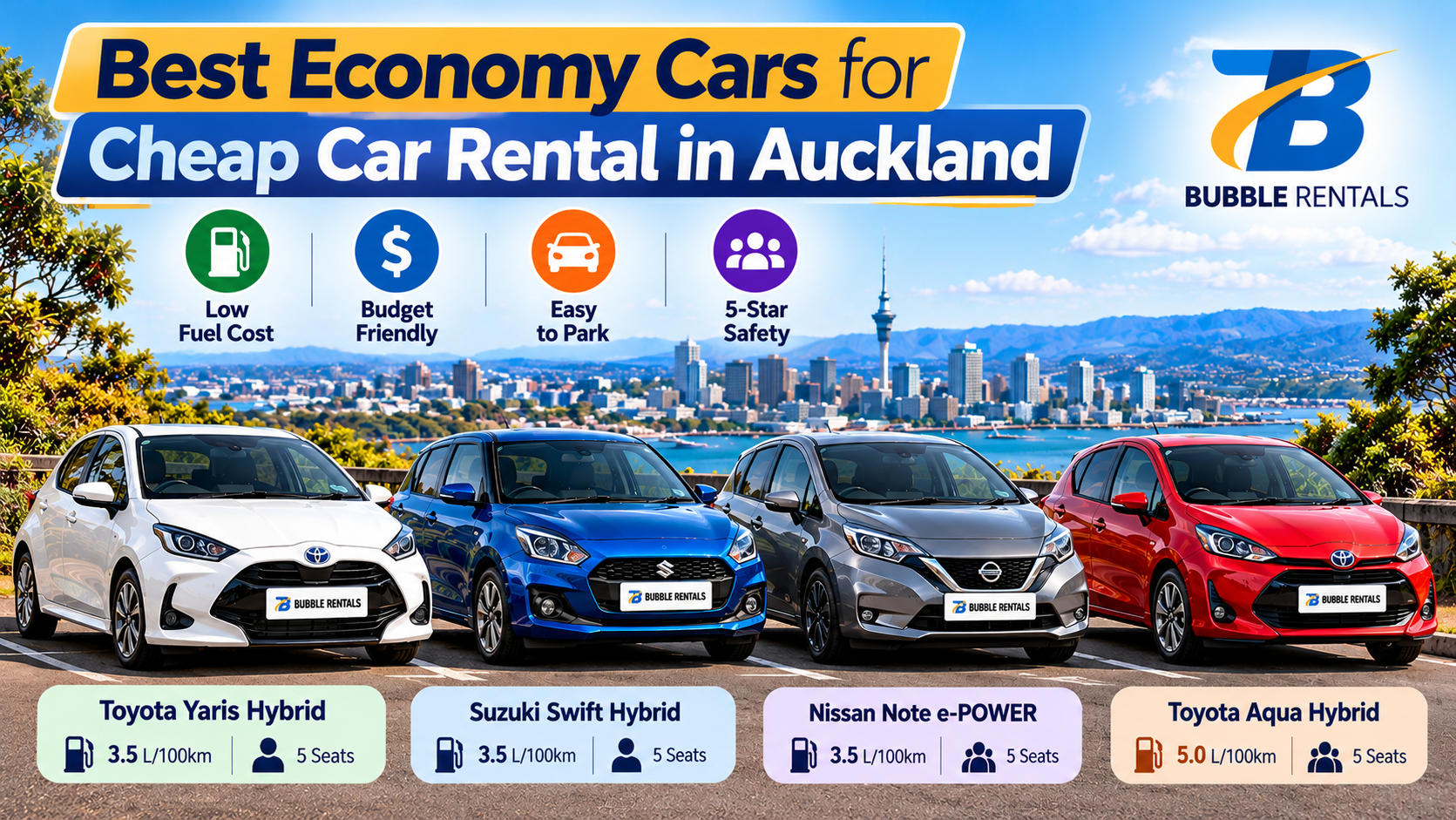
For most trips, a hybrid uses roughly half the fuel of a similar petrol car, which means noticeably lower fuel costs, especially over a few hundred kilometres or more. A petrol car is the better choice for short, low-distance trips, for specific needs like a certain seat count, or when the hybrid version of the car you want isn't available. Standard hybrids are self-charging, so there's nothing to plug in, and they don't pay Road User Charges either. Compare the total trip cost, not just the daily rate.
Most people pick a rental car by size and price, then glance at the fuel type as an afterthought. That's a mistake worth fixing, because fuel is usually the highest cost you control once the booking is made. This guide compares hybrid and petrol rentals on real numbers, so you can see when a hybrid pays for itself, when a petrol car is the better call, and what actually changes behind the wheel, whether you book with Bubble Rentals or anyone else.
How Hybrid and Petrol Rentals Actually Differ
A petrol car burns fuel in an engine to drive the wheels. A hybrid adds an electric motor and a small battery that help the engine, so it burns less fuel for the same distance.
Full Hybrids and Self-Charging
Most hybrids in rental fleets are full hybrids. The battery recharges itself while you drive, mainly by capturing energy when you brake, a process called regenerative braking. You fill the tank with ordinary petrol at any station, and you never plug anything in. The hybrids in our fuel-efficient cars range are all self-charging, so the experience at the pump is identical to a petrol car.
Mild Hybrids and e-POWER
Not every hybrid works the same way. A mild hybrid, like the Suzuki Swift Hybrid, uses a lighter electric system that assists the engine without driving the car on its own. The Nissan Note e-POWER is different again. Its petrol engine acts as a generator, and the electric motor drives the wheels. Both still run on petrol and need no charging, but the savings vary by system.
Fuel Use Compared: The Real Numbers
Claims about hybrid economy are easy to find and hard to compare, because manufacturers and sellers use different test methods. The table below uses a single yardstick: New Zealand's standardised fuel-economy ratings, which are WLTP-based and appear on vehicle listings across the country.

| Vehicle | Type | Rated Fuel Use | Fuel Cost per 1,000 km at $3.00 a Litre |
|---|---|---|---|
| Toyota Yaris GX 1.3 | Petrol | 7.0 L/100 km | $210 |
| Toyota Aqua (2013 to 2019 models) | Hybrid | 3.6 to 3.8 L/100 km | About $108 to $114 |
| Toyota Aqua (2021 on) | Hybrid | 2.9 L/100 km | $87 |
| Mitsubishi ASX LS 2.0 | Petrol | 8.5 L/100 km | $255 |
| Toyota RAV4 Hybrid AWD (2023) | Hybrid | 5.3 L/100 km | $159 |
The pattern is clear. Take the Toyota Yaris GX as the small petrol benchmark: at 7.0 litres per 100 km, it uses almost twice as much fuel as a first-generation Aqua. The SUV gap is smaller but still large, with the RAV4 Hybrid using about 38 percent less fuel than the ASX, even though the RAV4 is the bigger, all-wheel-drive vehicle.
These are rated figures. Real-world use is usually a little higher for every car, hybrid or petrol, so treat the table as a fair comparison between vehicles rather than a promise for your exact trip.
What the Difference Costs in Dollars
Percentages are abstract. Dollars are not. Here's what the gap between a small petrol car at 7.0 L/100 km and a first-generation Aqua at about 3.7 L/100 km looks like at $3.00 a litre.

| Trip Distance | Small Petrol | Small Hybrid | You Save |
|---|---|---|---|
| 600 km | $126 | About $67 | About $59 |
| 1,000 km | $210 | About $111 | About $99 |
| 2,000 km | $420 | About $222 | About $198 |
| 3,000 km | $630 | About $333 | About $297 |
Petrol prices move weekly, so check the current price before you plan around any figure. Our fuel costs guide covers current ranges and how to estimate your own route.
The Break-Even Question
The saving works out at about 10 cents for every kilometre driven. That gives you a simple way to judge whether a hybrid is worth any extra cost in the daily rate.
| If the Hybrid Costs This Much More per Day | It Breaks Even After About |
|---|---|
| $5 | 50 km a day |
| $10 | 100 km a day |
| $15 | 150 km a day |
This is arithmetic, not a price list. Your actual difference depends on the vehicle, the dates and the length of the booking. Our vehicle listings advertise unlimited kilometres, so on a road trip the distance you cover is limited only by your itinerary, and that's exactly the situation where fuel economy matters most. Always confirm the terms on your own booking.
Do Hybrids Pay Road User Charges?
No. Road User Charges apply to diesel vehicles, electric vehicles and plug-in hybrids. A standard self-charging hybrid runs on petrol, so it pays through fuel tax at the pump like any petrol car, with no distance-based charge on top. That makes the comparison with petrol a clean one, with no hidden extras. If you're weighing a diesel or an EV instead, our road user charges guide explains how that cost works.
Where Hybrids Save the Most
The saving isn't the same on every road.
- City and stop-start traffic: this is where a hybrid shines. Every time you brake, the system captures energy that a petrol car simply wastes as heat. Airport runs, central Auckland and suburban driving all play to this strength.
- Mixed driving: most holiday itineraries combine town, motorway and rural roads, and the combined ratings in the table reflect that mix.
- Steady open-road driving: hybrids still use less fuel, but the gap narrows, because there's less braking to recover energy from. Expect a smaller edge on long, flat highway stretches.
- Hills: the electric motor helps on climbs and recovers energy on descents, which suits much of New Zealand's terrain.
For compact city driving, the Toyota Aqua is a good example of a small hybrid built around exactly this kind of use.
Space, Luggage and Seats: Fuel Type Doesn't Decide Size
Choosing between hybrid and petrol is separate from choosing the size of the car. Pick the size first, then the fuel type within it.

Small Cars
Compact hatchbacks suit couples and solo travellers. Hybrid and petrol options exist at this size in our fleet, including the Nissan Note in both petrol and e-POWER forms.
Wagons and Mid-Size Cars
If boot space matters, look at the body style rather than the badge. Our vehicle page notes that the Corolla Touring wagon adds boot room, and the Corolla Touring Hybrid gives you that space without giving up the fuel saving.
SUVs
An SUV is where fuel use can climb fastest, so the hybrid advantage is worth more. The RAV4 Hybrid offers five seats and 4WD, which suits families with gear and trips that include gravel or hilly roads.
Larger Groups
For seven passengers, the Toyota Esquire Hybrid carries the group on the same self-charging principle as the smaller cars. Our range also includes the Estima Hybrid and the eight-seat Nissan Serena Hybrid. People movers burn more fuel than any other body style, so the savings from a hybrid grows with the size of the vehicle.
How a Hybrid Drives: What to Expect at Pickup
A hybrid feels different in a few small ways, and knowing them in advance takes the surprise out of the first ten minutes.

- It can be silent. Many hybrids start with only a "READY" light on the dash and no engine noise. The car is on. The engine may simply be off, so don't assume it needs restarting.
- The engine starts and stops by itself. It switches off at traffic lights and restarts as you pull away. That's normal.
- Low-speed quiet. Some hybrids move in near silence at car-park speeds, so watch for pedestrians who can't hear you coming.
- Smooth, continuous acceleration. Most hybrids use a CVT or e-CVT gearbox, which feels different from a conventional automatic. Under hard acceleration, such as overtaking on a hill, the engine can rev loudly.
- Descent settings. Some hybrids have a B or engine-braking setting for long downhill stretches. Ask about it at pickup if your route includes steep hills.
Everything else, from the controls to the pedals, works like any other automatic.
Hybrid Myths Worth Clearing Up
- "I'll have to plug it in." Not with a self-charging hybrid. You refuel at a normal petrol station.
- "Hybrids are slow." Everyday acceleration is fine for normal New Zealand driving. They aren't built for performance, but they're not underpowered for the road.
- "The battery is my problem." In a rental, servicing and maintenance sit with the provider, not you.
- "Hybrids need special fuel." Not normally. Check the fuel door or your handover notes for the correct grade.
- "Hybrids always cost more to rent." Not necessarily. Prices vary by model and dates, so compare the total for your trip.
When a Petrol Car Is the Better Choice
A hybrid isn't always the right answer. A petrol car makes sense when:
- Your trip is short and your driving low, so the fuel saving never grows large enough to matter.
- You need a specific feature or seat count that only a petrol model offers, such as the seven-seat Mitsubishi Outlander XLS.
- The hybrid version of the car you want isn't available for your dates.
- You're comfortable with the engine character of a conventional automatic.
For a roomy petrol option with a higher driving position, the Mitsubishi ASX is a straightforward compact SUV. It uses more fuel per kilometre, as the table shows, but for a short trip the difference is small in dollars.
Quick Decision Guide
| Your Situation | Better Fit |
|---|---|
| Mostly city driving and airport runs | Hybrid |
| A multi-day road trip of 1,000 km or more | Hybrid |
| A short weekend with little driving | Either, so compare the total price |
| A family needing boot space | A hybrid wagon or SUV |
| Seven or eight passengers | A hybrid people mover, or a petrol 7-seater if availability differs |
| You need one specific model or feature | Whichever version is available |
Questions to Ask Before You Choose
- What is the full price for my dates, hybrid and petrol, not just the daily rate?
- How many kilometres do I expect to drive in total?
- Does the car I want come in both versions, and are both available?
- Is there anything I should know about driving this particular hybrid?
- What fuel grade does it use?
For a deeper look at how hybrids save fuel and what drivers can do to get the most from one, our hybrid fuel savings guide goes through it in detail.
A Short Checklist
- Decide your seats and luggage needs first, then pick the fuel type within that size.
- Estimate your total distance, then use about 10 cents a kilometre as the hybrid saving on a small car.
- Compare the total trip price for hybrid and petrol, not the daily rate.
- Remember that hybrids need no plugging in and pay no Road User Charges.
- Ask about the quirks of your specific model at pickup.
- Check the fuel grade before your first fill-up.
Frequently Asked Questions
Is a hybrid cheaper than a petrol rental car in NZ?
The fuel is cheaper, often by about half for a small car, but the daily rate can differ. Compare the total trip cost. The more kilometres you drive, the more a hybrid saves.
How much fuel does a hybrid save compared with petrol?
On New Zealand's standardised ratings, a small hybrid like the Aqua uses about 3.7 litres per 100 km against about 7.0 for a small petrol car like the Yaris GX. That's close to half. In the SUV example, the RAV4 Hybrid uses about 38 percent less than the ASX.
Do I need to plug in a hybrid rental car?
No. The hybrids in our range are self-charging. You refuel with petrol, and the battery recharges as you drive.
Do hybrid rental cars pay Road User Charges?
No. Road User Charges apply to diesel, electric and plug-in hybrid vehicles. A standard hybrid runs on petrol and pays through fuel tax at the pump.
Is a hybrid good for long road trips in New Zealand?
Yes. It still uses less fuel than a similar petrol car, though the saving is smaller on steady highway driving than in the city. A longer trip also means more kilometres, so the dollar saving grows.
Do hybrids drive differently from petrol cars?
Slightly. Many are very quiet at low speed, the engine switches on and off by itself, and the gearbox feels smoother and sometimes louder under hard acceleration. The controls are the same as a normal automatic.
Which is better for a family, hybrid or petrol?
Choose the size first. A hybrid wagon like the Corolla Touring or a hybrid SUV or people mover gives you space with lower fuel use. Petrol makes sense if a specific model or seat count only comes in petrol.
When is a petrol rental better than a hybrid?
For short, low-distance trips, when you need a specific model, or when the hybrid version isn't available for your dates. Ready to compare cars for your trip? Our vehicle range shows every model with its seats and fuel type, and our FAQs cover anything this guide didn't.