Choose in this order: people, luggage, roads, then fuel. A small hatchback suits one or two people travelling light. Three or four people with normal holiday luggage are better in a mid-size wagon or a compact SUV. Five or six people need a larger SUV or a people mover, and seven or eight people need a seven- or eight-seat people mover, though boot space shrinks once every seat is taken. If you're torn between two sizes, lean towards the larger one, because luggage space is easy to underestimate. Our listings advertise unlimited kilometres, so size is about comfort and fuel, not a distance cap.
Booking the wrong size is one of the easiest mistakes on a road trip, and one of the hardest to fix once you're standing at the car with five bags and nowhere to put them. This guide shows how to match a car to your group, your luggage, and your route, so you pick the right size the first time, whether you collect your car from Bubble Rentals at Auckland Airport or anywhere else.
Start With Seats, Not Style
Seat count sets the minimum. Everything else, boot space, comfort and fuel, builds on it.

| Group | Seats You Need | Good Fit |
|---|---|---|
| 1 to 2 people, light luggage | 5-seat compact | Small hatchback |
| 2 to 3 people, normal luggage | 5-seat mid-size | Hatchback or sedan |
| 4 people on a week-long trip | 5-seat with a large boot | Wagon or SUV |
| 5 people | 5 seats is tight, 7 is easier | Larger SUV or a people mover |
| 6 to 8 people | 7 to 8 seats | People mover |
Here's a rule that saves arguments: a five-seat car carries five people, not five people and their luggage. Five adults and a week of bags rarely fit comfortably in a standard five-seater, so a seven-seater with the third row folded often works better for that group.
Luggage: What Actually Fits
People plan seats carefully and guess at luggage. That's where trips go wrong. Here are rough sizes to plan with.

| Bag | Rough Space It Takes |
|---|---|
| Cabin bag | About 35 to 40 litres |
| Medium suitcase | About 65 to 80 litres |
| Large suitcase | About 90 to 110 litres |
| Day pack or soft bag | About 20 to 30 litres |
A family of four on a week-long trip might carry two large suitcases, two cabin bags and a couple of day bags. That adds up to roughly 300 to 350 litres of packed space, and boots never pack perfectly. You want a boot comfortably bigger than the total, which points to a wagon or an SUV rather than a small hatch.
Body style matters more than the badge. In the European-market Corolla, for example, the hatch has roughly 310 to 360 litres of boot, while the Touring Sports wagon has roughly 580 to 600. Import-spec cars can differ, so treat that as a guide to the size of the gap, not a measurement of the car you'll get. Our car pages list seats but not boot volume, so if luggage is tight, ask the team to confirm what fits before you book.
Child Seats and Rear-Seat Space
Families need to plan for child restraints, because they take space and set rules.
- Under New Zealand law, children under seven must use an approved child restraint.
- A seven-year-old must use a restraint if one is available, and children aged eight to 14 must use a safety belt if one is available.
- NZTA recommends a booster or child restraint until a child is about 148 cm tall, or 11 years old.
- Two or three child seats can fill the back row of a small car, so check how the seats fit before you assume a compact will do.
If you're travelling with young children, a wagon or an SUV with a wide rear seat, or a people mover with sliding doors, gives you far more room to work with.
Small Cars: Couples and Light Packers
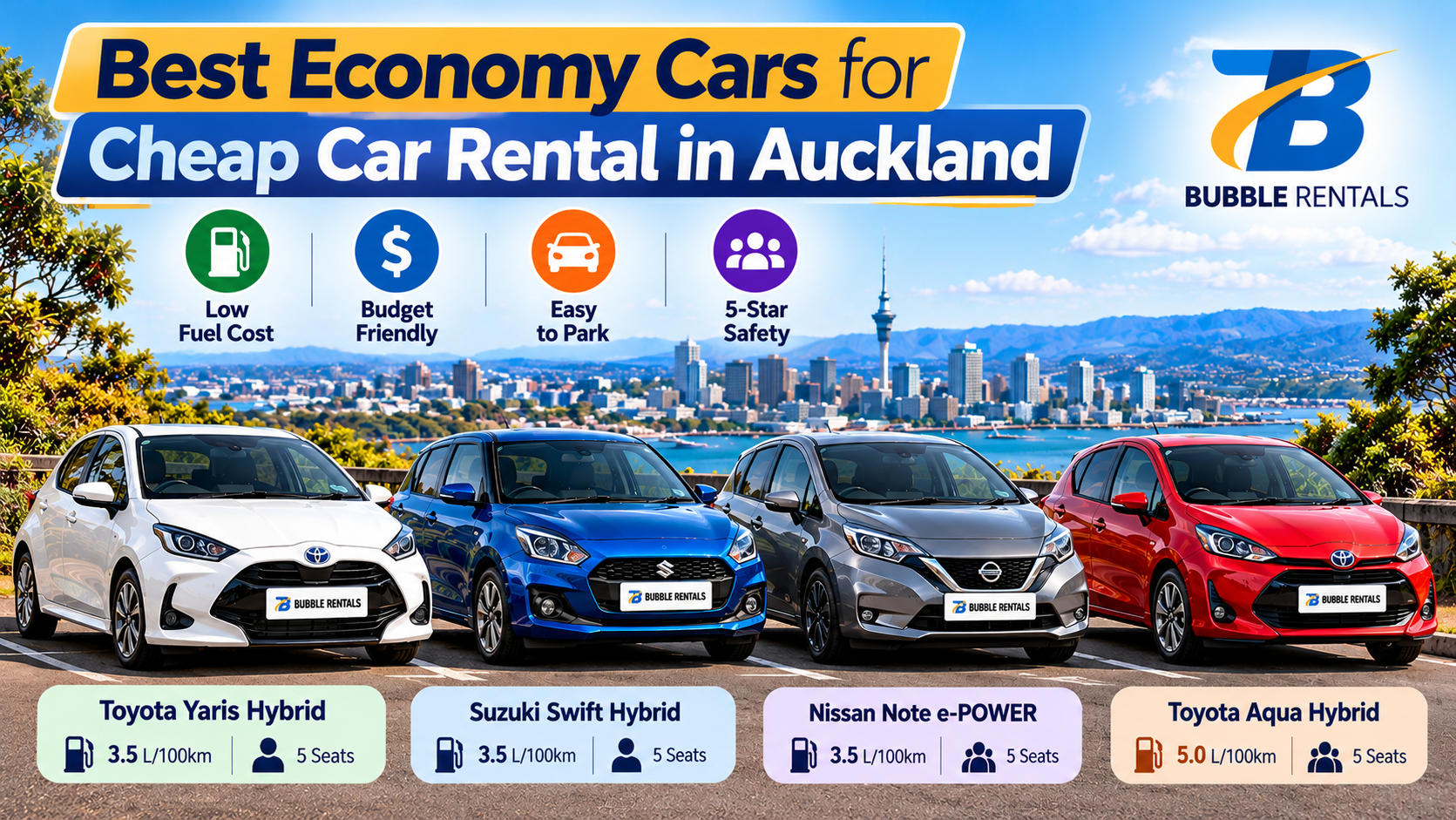
A small hatchback is the cheapest car in the range to run and the easiest to park. It suits one or two people who pack light, city-focused trips, and short drives out of Auckland. Our fuel-efficient cars range includes several compact hatchbacks, and the Toyota Aqua is a good example of the type.
- Best for: couples, solo travellers, airport runs, city driving.
- Watch out for: boot space with more than two people, and long days with tall passengers.
- Good rule: if your luggage is two cabin bags and one medium suitcase, a small car works.
Mid-Size Cars and Wagons: Four People or More Luggage
If you're four people, or two people with plenty of gear, a mid-size car gives you real boot space and rear-seat comfort. A wagon is the standout here, because the body shape adds boot room without adding bulk. The Corolla Touring Hybrid is a five-seat wagon built for this kind of trip.
- Best for: families of four, week-long trips, couples with lots of luggage.
- Watch out for: a sedan boot can be deep but have a narrower opening than a hatch or wagon.
- Good rule: for four people on a week-long trip, start your search with wagons and SUVs.
SUVs: A Higher Seat and More Room
SUVs give you a higher driving position, a bigger boot than most hatchbacks, and more flexibility if your route includes gravel or hilly roads. The RAV4 Hybrid is a five-seat SUV with 4WD, and our range also includes a petrol compact SUV and a seven-seat Outlander.
- Best for: families with gear, trips with mixed road types, travellers who like a higher view.
- Watch out for: a compact SUV does not always out-carry a wagon, so compare boot space, not body style.
- About 4WD: most North Island tourist routes are sealed, and 4WD matters mainly on gravel, steep or wet roads. Check your rental agreement for any rules about unsealed roads.
People Movers: Groups of Six to Eight
When you're a group of six or more, nothing else really works. A people mover seats the whole group together, with sliding doors and easy access to the back rows.

Seven Seats
The Toyota Esquire Hybrid seats seven. Our range also includes the Estima Hybrid and the seven-seat Mitsubishi Outlander.
Eight Seats
The Nissan Serena Hybrid seats eight, which makes it the choice for the largest groups.
One caution applies to every people mover. When every seat is occupied, the third row sits where the boot would be, so there's little room behind it. With seven or eight people, expect space for cabin bags and soft bags only. If your group has big suitcases, either fold a row, travel with fewer passengers per car, or consider a second vehicle.
Premium Cars: When Space and Comfort Matter
Long days and tall passengers make comfort count. Our premium cars page collects the roomier, higher-specification models in the range, which suits longer drives and travellers who want extra comfort. Size and comfort aren't the same thing, so check seats and boot space as well as the label.
Size and the Road Trip: Distance, Roads and Time
The route changes the answer too.
- Short trips: for a weekend away, a smaller car is fine if you pack light.
- Long days: if you'll spend many hours driving, extra legroom and a comfortable seat matter more than they do on a short hop. Our North Island itinerary shows how long multi-day routes can run.
- Souvenirs and shopping: you'll carry more on the way home than on the way out, so leave some spare room.
- Winding and narrow roads: a bigger vehicle takes more care on tight bends and single-lane bridges, especially while you're adjusting to driving on the left.
That last point deserves attention. Sitting on the right side of a wider car changes your sense of where the left edge of the road is. Our guide to driving on the left covers how to adjust, and a smaller car makes the first day easier.
Parking and Narrow Spaces: Bigger Isn't Always Easier
A large vehicle is harder to park, and cities are where that shows. Tall people movers can run into height limits in building car parks, and wide SUVs take more care in tight bays. Our Auckland parking guide explains how city parking works, which helps if your trip includes time in the central city.
Size and Running Costs

Bigger cars usually use more fuel, but fuel type changes the picture. Using New Zealand's standardised fuel-economy ratings at $3.00 a litre:
| Vehicle | Size | Rated Fuel Use | Fuel Cost per 1,000 km |
|---|---|---|---|
| Toyota Aqua (first generation) | Small hatchback | 3.6 to 3.8 L/100 km | About $108 to $114 |
| Toyota Yaris GX | Small hatchback | 7.0 L/100 km | $210 |
| Toyota RAV4 Hybrid AWD | Mid-size SUV | 5.3 L/100 km | $159 |
| Mitsubishi ASX LS 2.0 | Compact SUV | 8.5 L/100 km | $255 |
On these ratings, a hybrid SUV uses less fuel than a small petrol hatchback. So don't assume a smaller car is always the cheaper car to run. Rated figures are lab based and real-world use is usually a little higher, and petrol prices change weekly. Our fuel costs guide covers current ranges and how to estimate your own route.
Common Mistakes When Choosing a Size
- Booking by seat count only, then finding the boot can't hold the luggage.
- Forgetting child seats, which take up rear-seat space.
- Assuming an SUV always has a bigger boot than a wagon.
- Choosing a people mover for six people, then discovering the third row eats the luggage space.
- Booking the smallest car to save money, then paying for it in a cramped, tiring trip.
- Ignoring the return leg, when the luggage is heavier from shopping and souvenirs.
Quick Decision Guide
| Your Trip | Better Fit |
|---|---|
| Couple, light luggage, mostly city | Small hatchback |
| Couple, lots of luggage | Wagon or compact SUV |
| Family of four, a week | Wagon or SUV |
| Family with young children and gear | SUV or people mover |
| Five adults with luggage | Larger SUV or a seven-seater |
| Six to eight people | People mover |
| Gravel roads or hilly routes | SUV, with 4WD if the road needs it |
Questions to Ask Before You Book
- How many people will travel, and how many are children needing seats?
- How many bags will we carry, and how big are they?
- Does the car's boot comfortably hold them all, with room for the trip home?
- Does the route include gravel, steep or narrow roads?
- Does the vehicle's size suit my comfort with left-side driving?
A Short Checklist
- Count people first, then add luggage.
- Add child seats to your seat-and-space plan.
- Pick the size that holds your bags comfortably, not just barely.
- Check fuel use alongside size, since a hybrid can change the sums.
- Confirm boot space and seat count on the listing, or ask the team.
Frequently Asked Questions
What size rental car do I need for a road trip in New Zealand?
Match it to people and luggage. A small hatchback suits one or two people travelling light, a wagon or compact SUV suits three or four, and a people mover suits six to eight.
What size car do I need for four people with luggage?
A wagon or an SUV is the usual answer. A small hatchback is too tight for four people and a week of luggage.
Can five adults fit in a standard rental car with luggage?
It's tight. A five-seat car seats five, but five adults and their bags rarely fit comfortably, so a seven-seater with the third row folded often suits that group better.
Do people movers have luggage space when all seats are used?
Very little. With every seat taken, the third row sits where the boot would be, so expect room only for cabin bags and soft bags.
How do I know if my luggage will fit?
Count your bags, estimate their size, and compare with the boot. Our car pages list seats but not boot volume, so ask the team to confirm if it's tight.
Do I need a 4WD for a New Zealand road trip?
Usually not. Most North Island tourist routes are sealed, and 4WD helps mainly on gravel, steep or wet roads. Check your rental agreement for rules about unsealed roads.
Are bigger rental cars harder to drive in New Zealand?
They need more care on narrow roads, single-lane bridges and in tight car parks, especially while you're adjusting to driving on the left. A smaller car makes the first day easier.
Does a bigger car always use more fuel?
Not always. On New Zealand's standardised ratings, a hybrid SUV uses less fuel than a small petrol hatchback, so check the rated figure as well as the size.
What are the child seat rules in New Zealand?
Children under seven must use an approved child restraint. Seven-year-olds must use one if it's available, and children aged eight to 14 must use a safety belt if one is available.
Ready to compare cars by seats and size? Our vehicle range shows every model, and our FAQs cover anything this guide didn't.