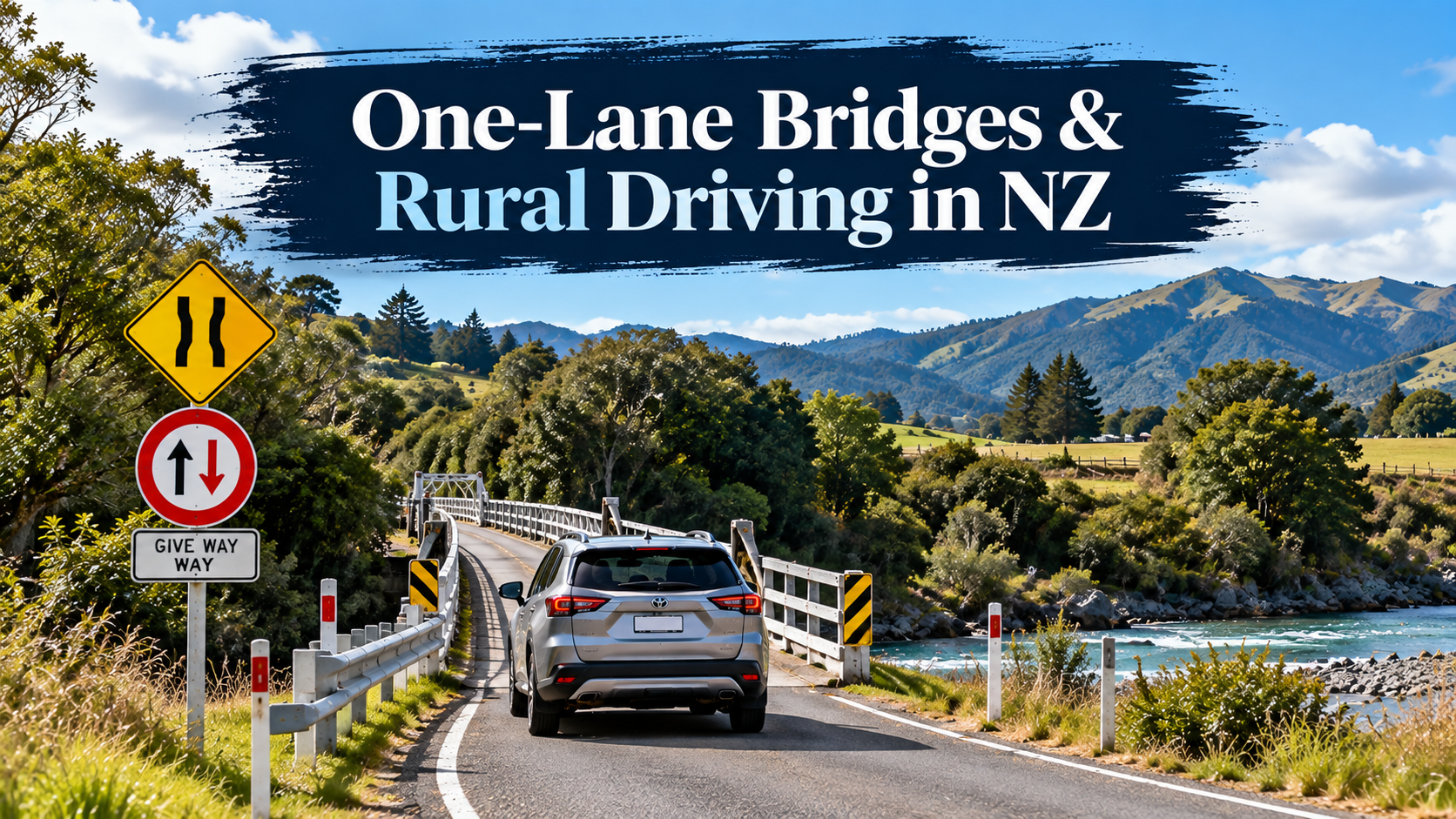
At a New Zealand one-lane bridge, signage tells you who goes first. A red circle sign means you must give way to oncoming traffic. A blue rectangle with a white arrow means you have priority, though you still need to give way to any vehicle already on the bridge. Slow down, check for oncoming traffic, and only proceed if the bridge is clear. Beyond bridges, rural roads in New Zealand often bring gravel sections, livestock, logging trucks, patchy phone coverage and fewer fuel stations, all of which reward a slower, more attentive driving style than a main highway does.
New Zealand's back roads are where the scenery gets genuinely spectacular, winding past farmland, native bush and quiet river crossings, and also where the driving gets genuinely different from a city motorway. One-lane bridges are the hazard most visitors ask about by name, but they're really just one part of a wider set of conditions that rural roads bring, from loose gravel to the occasional herd of sheep taking up the whole lane. This guide covers both: how one-lane bridges work, and everything else you need to know before you turn off the main highway.
Understanding One-Lane Bridge Signs

New Zealand has many one-lane bridges, mostly on quieter rural roads but also on some genuinely busy tourist routes, so recognising these signs matters even on a popular holiday drive. Every one-lane bridge is clearly signposted to show who gives way, and the system is consistent nationwide.
When You Must Give Way
If you see a round sign with a red border and a red arrow pointing up with a larger black arrow pointing down, you must give way to any vehicle coming from the other direction. This is usually paired with a yellow diamond warning sign showing a stylised bridge icon, positioned further back to give you advance notice that a one-lane bridge is coming up.
When You Have Priority
If you see a blue rectangular sign with a larger white arrow pointing up and a smaller red arrow pointing down, you have priority to cross first. This does not mean you can proceed without looking. You must still give way to any vehicle already on the bridge or already committed to crossing when you arrive, regardless of which sign you're looking at.
What to Do When You Reach a One-Lane Bridge
The signage tells you the rule, but the actual approach is the same simple sequence every time, whichever side of the priority you're on.
- Slow down well before the bridge, since many are on bends or dip down toward a river crossing with limited visibility.
- Check for oncoming traffic, including vehicles that may already be partway across.
- If you have to give way, stop clear of the bridge entrance and wait for the bridge to be completely clear before proceeding.
- If you have priority, still check the bridge is clear before committing, since a vehicle already on it has the right to finish crossing regardless of the sign.
- Keep left as you exit the bridge. Busier one-lane bridges often have an arrow painted on the road at the exit as a reminder.
Reading the Road Markings on the Approach
Signage isn't the only cue. New Zealand also paints markings directly on the road surface ahead of one-lane bridges, which is useful if a sign is obscured or you're approaching at a moment when it's hard to glance up.
- The words ONE, LANE and BRIDGE are often painted across the approach, spaced out over roughly 50 metres before the bridge itself.
- Edge lines taper inward as the road narrows toward the bridge, visually signalling the reduced width before you're on it.
- Reflective markers are commonly fixed to the bridge parapets on both sides, useful for judging the bridge's edges at night or in poor light, since the structure itself is narrower than the road leading up to it.
Driving a Larger Vehicle or Towing Through a One-Lane Bridge
.png)
A motorhome, a larger SUV, or anything towing a trailer needs a bit more care at a one-lane bridge than a standard car does, mostly down to timing rather than any different rule.
- Larger vehicles take longer to get up to speed again after stopping, so if you have priority, commit to crossing fully once you start rather than hesitating partway.
- If you're giving way, allow extra space before pulling back onto the road once the bridge is clear, since a wider vehicle needs more room to straighten up on the narrower carriageway.
- Towing a trailer adds length that takes longer to clear the bridge entirely, so factor that into how much gap you need from an oncoming vehicle before you commit to going first.
The give way rule itself doesn't change based on vehicle size. What changes is how much margin you should give yourself before deciding it's safe to proceed.
A Realistic Example: A Coastal Back Road
Picture a drive along a quiet coastal route, the kind where the road narrows as it drops toward a river mouth. You see the yellow diamond bridge warning sign first, then, as you get closer, a round sign with a red border, telling you to give way. You slow down. As you approach the bridge entrance, you can see it's clear, with no vehicle on it or visibly approaching from the other side, so you proceed, keeping left as you exit onto the narrower stretch beyond.
A few kilometres further on, the road brings you to a second one-lane bridge, this time with a blue rectangular sign showing you have priority. You still slow down and check before committing, since a car already partway across would still have the right to finish crossing. Finding the bridge clear, you go first, and the oncoming vehicle you can now see approaching waits for you to clear it before it starts across.
This is the entire interaction, repeated with small variations at every one-lane bridge across the country. Once you've done it a few times, it stops requiring much conscious thought at all, and becomes just another part of the rhythm of a rural drive.
Why New Zealand Has So Many One-Lane Bridges
Much of New Zealand's rural road network was built decades ago, when traffic volumes were a fraction of what they are now and a single-lane structure was simply cheaper to build and maintain than a full two-lane bridge. Many of these bridges have never needed replacing, since the road they sit on still carries light enough traffic to make a one-lane crossing workable, and the cost of widening a structure for a few dozen vehicles a day rarely gets prioritised over busier routes elsewhere. You'll find them scattered across quiet back roads throughout both islands, and also on a handful of busier seasonal routes, the Thames Coromandel coast road among the most well known, where our Auckland to Coromandel road trip guide covers several of them directly on route.
Beyond Bridges: Other Rural Driving Conditions to Expect
One-lane bridges get the most attention, but they're one feature among several that make rural New Zealand driving feel different from a city or motorway trip. Knowing what else to expect makes the adjustment far smoother.

Gravel and Unsealed Roads
Not every road on a map is sealed. Some rural routes, particularly ones leading to remote beaches, lookout points or back-country access points, turn to loose gravel without much warning. Reduce your speed well before the surface changes, avoid sudden braking or sharp steering input on loose stone, and give extra following distance to the vehicle ahead, since gravel roads throw up dust and loose chips that reduce visibility and traction alike.
Livestock on the Road
It's genuinely common to encounter sheep or cattle being moved along a rural road, sometimes with a farm vehicle or dog managing them and sometimes not. Slow right down well in advance, avoid sounding your horn, which can scatter animals unpredictably, and simply wait for a clear path rather than trying to push through a herd.
Logging Trucks and Slow-Moving Vehicles
Forestry regions carry a steady flow of large logging trucks, which are slower to accelerate, slower to stop and wider on tight bends than a typical car. Give them extra room, avoid overtaking on a blind corner just because a stretch of road looks clear, and expect them to use the full width of their lane on narrow sections.
Patchy Cellphone Coverage
Mobile coverage drops out across large sections of rural New Zealand, particularly in hill country and native forest. Download offline maps before you set off on a rural route, and don't rely on a live navigation app to reroute you if you miss a turn somewhere with no signal.
Fewer Fuel Stations
Service stations thin out noticeably once you're off the main state highways. Fill up before heading into a rural loop rather than assuming you'll find a station along the way, particularly on longer back-country routes where the next pump could be well over an hour away. A hybrid rental stretches that margin further if fuel planning is a genuine concern for your route.
Passing Bays and Slower-Moving Traffic
Many rural roads narrow enough that overtaking isn't straightforward, and New Zealand uses passing bays, short widened sections built specifically for this, to manage it.
- If you're driving slower than the traffic behind you, pull into a passing bay when it's safe to let faster vehicles through, rather than holding up a queue on a narrow stretch.
- If you're the one catching up to a slower vehicle, wait for a passing bay or a genuinely clear straight rather than attempting to overtake on a blind bend.
- Passing bays are typically signposted in advance, giving both the slower and faster driver time to prepare for the exchange.
Weather and Visibility on Rural Back Roads
Conditions change faster on rural roads than on a well maintained state highway, and the margin for error is smaller.
- Fog settles more heavily in valleys and near rivers, often right where a one-lane bridge happens to sit.
- Heavy rain can affect unsealed sections more severely than sealed ones, softening the surface and reducing traction noticeably.
- Shade from dense bush can leave sections of road wet or icy well after the surrounding area has dried out, particularly in cooler months.
Treat the posted speed limit on a rural road as a maximum for ideal conditions, not a target regardless of what you're actually driving through. A tight corner, a patch of shade or a sudden gravel section can all call for a slower speed than the sign technically allows, and adjusting for what you can actually see ahead matters more than matching the number on the post. For more on how speed limits and road rules apply generally, our driving rules guide covers the broader picture alongside this rural-specific detail.
A Short Checklist Before a Rural Drive
- Check your planned route for one-lane bridges and gravel sections in advance, and expect to slow down for both.
- Download offline maps before you lose phone signal, rather than relying on live navigation the whole way.
- Fill up with fuel before entering a longer rural loop, not partway through it.
- Keep extra following distance behind farm vehicles, logging trucks and livestock, and never use your horn to move animals along.
- Use passing bays rather than overtaking on a blind bend, whichever side of the slower traffic you're on.
If you're new to driving on New Zealand's left-hand side as well as its rural roads, our guide to driving on the left covers the adjustment most visitors ask about first, before you even reach your first one-lane bridge.
Frequently Asked Questions
How do I know who has priority at a one-lane bridge in New Zealand?
Signage tells you directly. A red circle sign means you must give way to oncoming traffic. A blue rectangle with a white arrow means you have priority, though you must still give way to any vehicle already on the bridge.
What happens if two cars arrive at a one-lane bridge at the same time?
Whoever the sign gives priority to proceeds first. If you're on the give way side, wait for the bridge to be fully clear, even if you technically arrived first, since the priority sign governs the outcome, not arrival order.
Are one-lane bridges common on main tourist routes in New Zealand?
Yes, on some. Most are on quiet rural roads, but a handful of well-known scenic routes, including the Thames Coromandel coast road, have several one-lane bridges directly on the main route.
Is it safe to drive a rental car on unsealed rural roads in New Zealand?
Generally yes, at a reduced speed appropriate to the surface. Check your specific rental agreement for any restrictions on unsealed roads, since policies vary between providers.
What should I do if I meet livestock on a rural road?
Slow down well in advance, avoid using your horn, and wait for a clear path rather than attempting to push through. A farmer or working dog is often managing the herd nearby.
Why do some New Zealand bridges only have one lane?
Many were built when traffic volumes were much lower, and a single-lane structure was simpler and cheaper to construct and maintain. Light traffic on many of these roads has meant there's been no need to widen them since.
Do I need offline maps for rural New Zealand driving?
It's a good habit. Mobile coverage drops out across large parts of rural New Zealand, particularly in hill country, so downloading your route in advance avoids being caught without navigation partway through a trip.
Does towing a trailer change the rules at a one-lane bridge?
No, the give way rule stays the same regardless of vehicle size. What changes is the margin you should allow yourself, since a longer vehicle takes more time and space to clear the bridge once committed.
Can I overtake another car on a rural one-lane road?
Only in a designated passing bay or a genuinely clear, straight section with good visibility well ahead. Overtaking on a blind corner or near a one-lane bridge is both against safe driving practice and specifically dangerous given the narrow margins involved.
At Bubble Rentals, our team is happy to talk through which routes on your itinerary involve rural or unsealed driving, so you know what to expect before you leave the city behind.