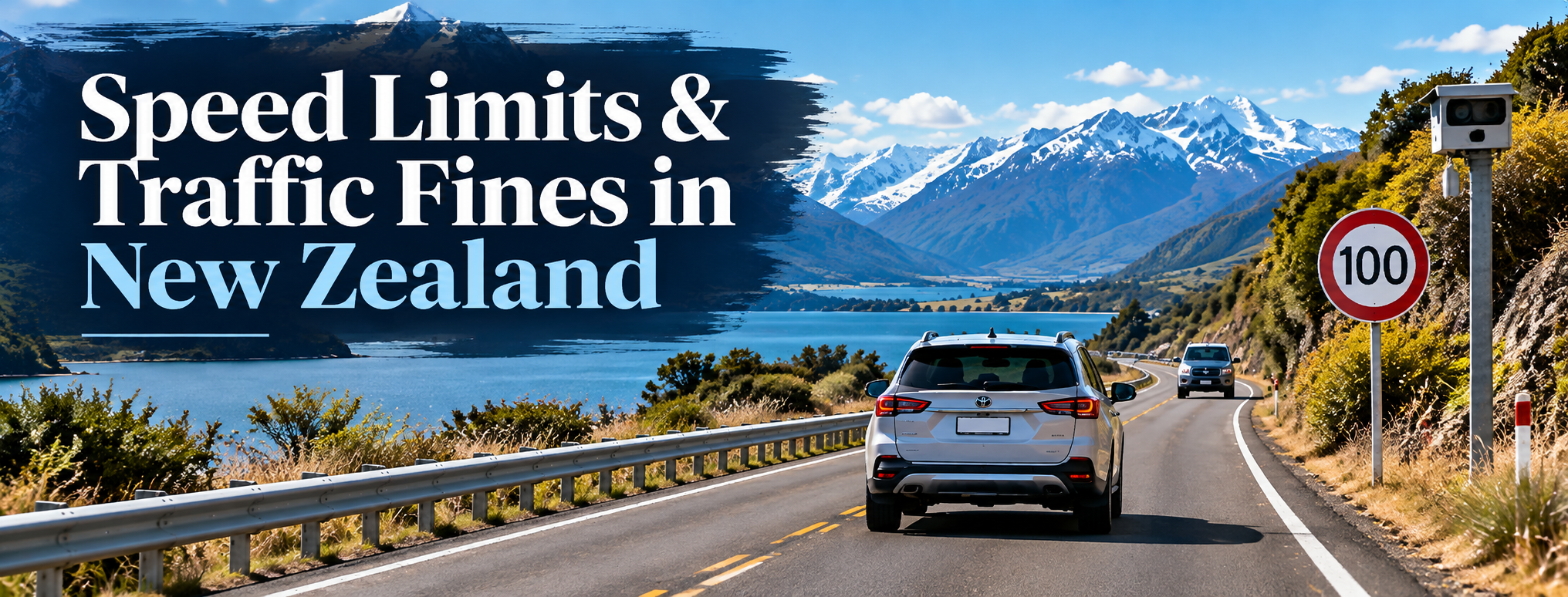
New Zealand's default speed limits are 50 km/h in urban areas, 100 km/h on the open road, and some sections of motorway posted at 110 km/h. Speeding fines start at $30 for being 10 km/h or less over the limit and rise to $630 for 46 to 50 km/h over. More than 40 km/h over can mean a 28-day licence suspension, and more than 50 km/h over can mean a careless or dangerous driving charge in court. Most other common fines, including mobile phone use, not wearing a seatbelt, and failing to give way, sit at a flat $150.
Speed limits in New Zealand are straightforward on paper, but the fine schedule behind them catches a lot of drivers off guard, tourists especially. This page is the complete reference: every default speed limit, the exact fine for each band of speeding, how demerit points work, and what the other common traffic fines actually cost.
New Zealand's Default Speed Limits

Speed limits are set per road, not applied as one blanket national number, so the figure that matters is whatever is posted on the signage for the stretch you're driving, not a general assumption based on road type.
| Road Type | Typical Speed Limit |
|---|---|
| Urban and residential streets | 50 km/h |
| School zones (during posted times) | 30 km/h |
| Open rural roads | 100 km/h |
| Some motorways and expressways | 110 km/h, where the road is built to that standard |
| Narrow, winding or coastal roads | Often lower than the posted limit in practice |
Why Posted Limits Can Differ From What You Expect
Speed limits in New Zealand have been reviewed and adjusted on various roads in recent years, with some limits lowered around schools and high-risk stretches and others raised back up on roads engineered for higher speeds. Because of this ongoing review process, the safest approach is to treat every stretch of road on its own signage rather than assuming a limit based on how a similar-looking road was signed elsewhere.
The Difference Between a Limit and a Safe Speed
The posted number is a legal maximum, not a target to drive at regardless of conditions. On a winding rural road or in heavy rain, driving at the full 100 km/h limit can still be considered careless driving if it's not a safe speed for the conditions. The limit tells you what's legally allowed. Conditions tell you what's actually sensible, and a court can still find a driver at fault for travelling too fast for the conditions even when they were technically within the posted number.
The Speeding Fine Schedule

This is the exact fine schedule used by NZ Police for speeding infringements, based on how far over the posted limit a driver was travelling.
| How Far Over the Limit | Infringement Fine |
|---|---|
| 10 km/h or less | $30 |
| 11 to 15 km/h | $80 |
| 16 to 20 km/h | $120 |
| 21 to 25 km/h | $170 |
| 26 to 30 km/h | $230 |
| 31 to 35 km/h | $300 |
| 36 to 40 km/h | $400 |
| 41 to 45 km/h | $510 |
| 46 to 50 km/h | $630 |
What Happens Above 50 km/h Over the Limit
Beyond 50 km/h over the posted limit, a fixed infringement fine no longer applies. Instead, the offence is typically treated as careless, dangerous or reckless driving, which goes through the court system rather than a standard ticket, and carries far more serious consequences than a fine alone, including a higher court-set penalty and a longer period without a licence.
Licence Suspension at Higher Speeds
Speeding at more than 40 km/h over the limit can result in an immediate 28-day licence suspension on top of the fine itself. At more than 50 km/h over, that suspension applies alongside the possibility of a careless or dangerous driving charge.
How Demerit Points Work

Alongside a fine, many traffic offences, speeding included, add demerit points to a driver's record. These points exist as a separate layer from the fine, tracking a pattern of repeated offending over time rather than punishing a single incident in isolation.
| Speeding Offence | Demerit Points |
|---|---|
| More than 10 km/h but not more than 20 km/h over | 20 |
| More than 20 km/h but not more than 30 km/h over | 35 |
| More than 30 km/h but not more than 35 km/h over | 40 |
| More than 35 km/h over | 50 |
If a driver accumulates 100 or more demerit points within any two-year period, their licence is suspended for three months. NZTA also sends a notification letter once a driver reaches 50 points, as an earlier warning before the suspension threshold.
Do Speed Camera Tickets Carry Demerit Points?
Speed-related infringements caught specifically by an automated speed camera, rather than an officer directly observing and stopping the vehicle, generally don't carry demerit points, only the fine itself. An officer-issued speeding ticket does carry both.
How a Speeding Infringement Actually Gets Issued
There are two separate ways a speeding offence reaches you, and they work differently.
- An officer who stops you directly issues a ticket on the spot, and this type carries both the fine and any applicable demerit points.
- A fixed or mobile speed camera captures the offence electronically, and the notice is posted to the vehicle's registered owner afterward, generally with the fine only and no demerit points attached.
For a rental car, a camera-issued notice goes to the rental company first, the same way an unpaid toll does, since the company is the registered owner on record. This is part of why it can take weeks for a notice to catch up with a driver who has already returned home.
Alcohol and Drug Driving Penalties
While speeding and the fixed-fee offences above are handled through infringement notices, alcohol and drug driving offences are treated far more seriously and generally go through the court system rather than a standard ticket.
- Exceeding the legal breath or blood alcohol limit can result in a fine set by the court, a driving disqualification, and in more serious cases, imprisonment.
- Roadside drug testing that detects a qualifying drug carries its own infringement structure, with a $200 fine and 50 demerit points for one drug detected, rising to a $400 fine and 75 demerit points for two or more drugs detected.
- Repeat offences or high-range results typically carry heavier court-imposed penalties, including longer disqualification periods and mandatory alcohol interlock requirements once a licence is reinstated.
Because court-imposed penalties vary by circumstance rather than following a fixed schedule like speeding does, there's no single dollar figure to quote here. The consequences are consistently more severe than any of the infringement-only offences covered above.
Other Common Traffic Fines
Speeding gets most of the attention, but several other everyday offences carry fixed fines that catch drivers, visitors especially, off guard just as often.
| Offence | Fine | Demerit Points |
|---|---|---|
| Using a mobile phone while driving | $150 | 20 |
| Not wearing a seatbelt | $150 | None |
| Failing to stop at a stop sign | $150 | None |
| Failing to give way at a give way sign | $150 | None |
| Failing to give way at a roundabout | $150 | None |
| Failing to stop for police (red and blue lights) | $150 | None |
Why So Many Fines Sit at the Same Figure
Most of New Zealand's standard moving-vehicle fines have stayed at $150 since being aligned at that figure, with mobile phone use the most recent to join that list in 2021 after sitting lower for over a decade. Motoring advocacy groups have argued these flat fines, unchanged since 1999 in most cases, no longer carry the deterrent value they once did, and have pushed for inflation-adjusted increases. Nothing has changed as of the time of writing, but it's a live policy debate worth being aware of if you're reading this some time after publication.
How This Affects Tourists Driving Rental Cars
A ticket issued to a rental car doesn't disappear just because the driver leaves the country before it's processed.
- NZ Police issue the infringement notice to the vehicle's registered owner, which for a rental car is the rental company, not the individual driver.
- Most rental companies then pass the fine on to whoever was driving at the time, typically charged to the card used for the booking.
- An administration fee is commonly added on top of the fine itself to cover the rental company's processing cost.
- Demerit points apply to the driver's own licence record in the system that issued it, which in practice has limited effect on a short-term visitor's home country licence, though the fine itself still needs to be paid regardless.
Our page on transparent rental pricing explains how charges like this fit into the broader picture of what's included in a quoted rental rate and what gets billed afterward.
Where Speed Enforcement Is Most Common
A handful of situations account for a large share of speeding tickets issued to visitors specifically, mostly because they're easy to misjudge without local experience.
- Dropping speed too slowly after leaving an open road section and entering a town, where the limit can fall from 100 km/h to 50 km/h with relatively short notice.
- School zones with a temporary 30 km/h limit that only applies during specific posted hours, easy to miss if you're not watching for the variable signage.
- Holiday periods, when police enforcement activity typically increases on popular tourist routes.
- Roads that look like open highway but are actually signed lower due to tight curves or a history of crashes, where the number on the sign matters more than how the road visually appears.
A Short Checklist Before You Drive
- Watch for speed limit signage at every change, rather than assuming a limit based on road type or your previous route.
- Treat the posted limit as a maximum, not a target, especially in poor weather or on unfamiliar winding roads.
- Keep your phone mounted and hands-free if you need it for navigation, since handling it while driving carries the same fine as speeding moderately over the limit.
- Check with your rental company in advance how an infringement notice would be billed to you, so there are no surprises after you've returned home.
For everything else that applies on the same roads, our complete driving rules guide covers give way rules, road signs and the rest of what a first-time visitor needs to know.
How to Pay a Traffic Fine in New Zealand
If you're issued a ticket directly rather than through a rental company, payment is handled through NZ Police rather than NZTA.
- Infringement notices can generally be paid online directly to police, using the notice number printed on the ticket.
- Payment is typically due within 28 days of the notice being issued.
- If a fine goes unpaid past that window, it can be referred for further enforcement action, which may include additional costs on top of the original fine.
- For a rental vehicle, the practical outcome is usually that the rental company settles the fine with police directly, then recovers the cost from the renter's payment method on file.
Disputing a Fine
If you believe a ticket was issued incorrectly, there is a formal process for challenging it rather than simply ignoring the notice.
- You can request a hearing to dispute the fine through the court process named on the infringement notice itself.
- If a dispute goes to a court hearing, the outcome isn't guaranteed to be in your favour. The fine could be reduced, confirmed as issued, or in some cases increased if the matter is treated as a more serious offence once reviewed.
- Ignoring a fine rather than either paying it or formally disputing it doesn't make the issue go away, and generally leads to the same enforcement escalation as simply not paying.
For a short visit, weigh the time and cost of disputing a minor fine against simply paying it, since the formal process is designed for genuine disputes rather than as a general delay tactic.
Frequently Asked Questions
What is the speed limit in New Zealand?
The default is 50 km/h in urban areas and 100 km/h on the open road, with some motorways posted at 110 km/h where the road is built to that standard. Always follow the posted sign for the specific stretch you're on.
How much is a speeding ticket in New Zealand?
It ranges from $30 for being 10 km/h or less over the limit to $630 for 46 to 50 km/h over, calculated on a sliding scale based on exactly how far over you were travelling.
Do speeding fines come with demerit points?
Yes, for officer-issued tickets. Points range from 20 for 10 to 20 km/h over, up to 50 for more than 35 km/h over. Automated speed camera infringements generally carry the fine only, with no points.
What happens if I lose my licence for demerit points in New Zealand?
Accumulating 100 or more demerit points within any two-year period results in an automatic three-month licence suspension, regardless of which individual offences made up that total.
How much is the fine for using a mobile phone while driving in New Zealand?
$150, along with 20 demerit points, the same as several other moving vehicle offences carrying that points value.
Does a seatbelt fine apply to passengers too?
Yes. A $150 fine can apply for each person in the vehicle not wearing a seatbelt correctly, not only the driver.
Will I still have to pay a speeding fine if I've already left New Zealand?
Yes. If the ticket was issued to a rental car, most companies charge the fine, often with an added administration fee, to the card used for the original booking once they receive the notice from police.
Is there a tolerance before police enforce a speeding offence?
Police have the legal authority to enforce from any speed above the posted limit, though in practice a small buffer is commonly applied for drivers who are otherwise driving safely. This isn't a guaranteed entitlement, and the only reliable way to avoid a ticket is to stay within the posted limit itself.
How long does a traffic fine stay on record in New Zealand?
Demerit points are cleared from a driving record after a set period without further offences, generally around two years, though a fine itself remains a matter of payment record rather than something that simply expires if left unpaid.
At Bubble Rentals, we're upfront about how any fine or infringement notice would be handled on your booking, so there's nothing to untangle after the fact if you're ever unsure.