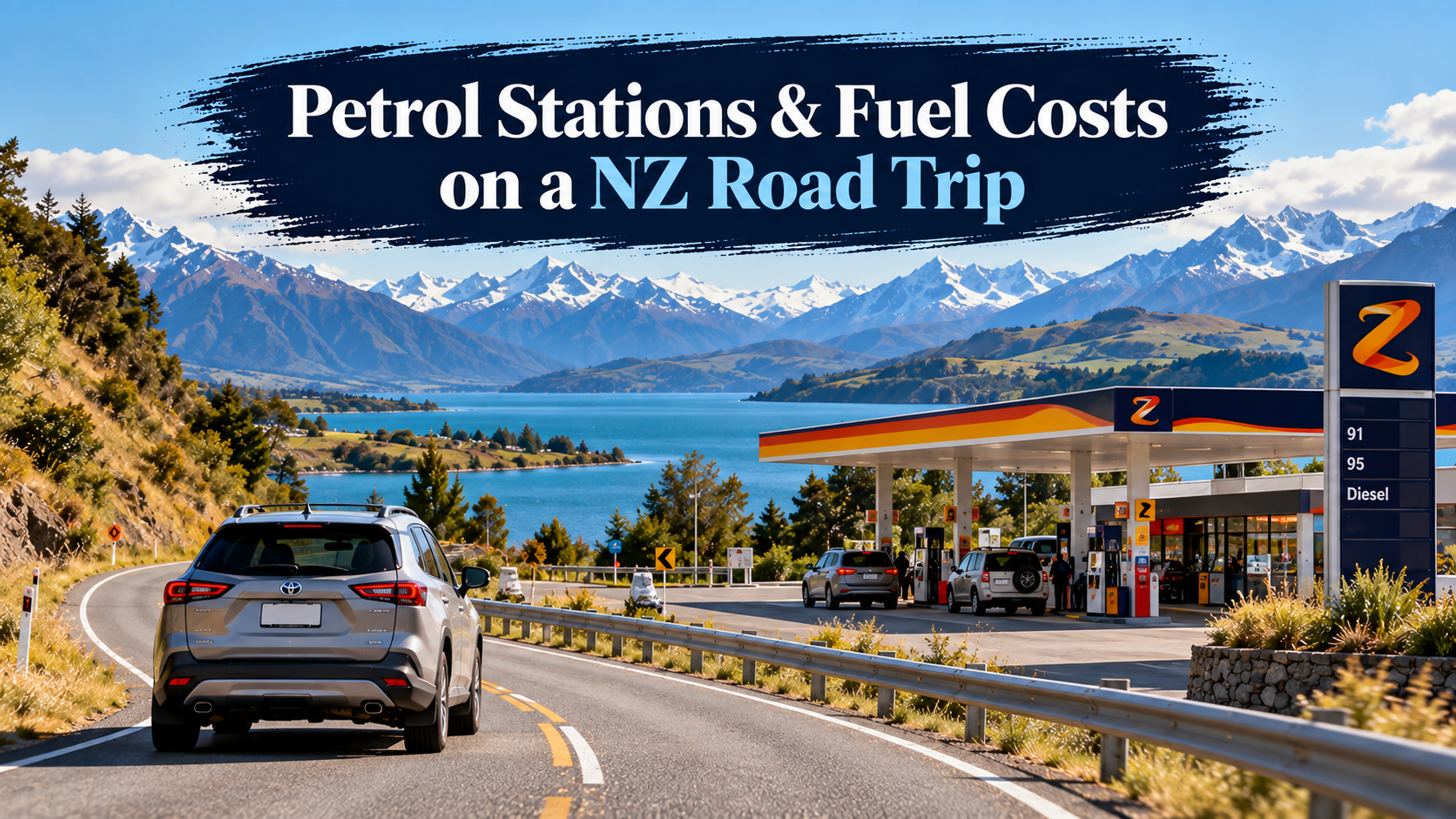
As of late 2026, 91-octane petrol in New Zealand has generally sat somewhere between $2.90 and $3.30 per litre, depending on the week, the region, and global oil prices, with diesel usually 40 to 60 cents per litre cheaper. Prices move often enough that checking a live fuel price app before a long trip is more useful than relying on any single figure, including the ones in this article. Expect to budget roughly $12 to $16 per 100 km for an average petrol car at current prices, less for a fuel-efficient hybrid.
Fuel is usually the most visible ongoing cost of a New Zealand road trip, and the one most visitors have the least intuition for, since neither the prices nor the distances quite match what they're used to at home. A number that looks reasonable per litre can still add up differently than expected once a day of driving stretches well beyond what felt like a short hop on the map. This guide covers what petrol actually costs right now, where stations are easy to find and where they're not, and how to put together a realistic fuel budget before you set off. Our vehicle range includes several fuel-efficient options if keeping this cost down is a priority for your trip.
How Much Does Petrol Actually Cost Right Now

Fuel pricing in New Zealand changes weekly, sometimes daily, so treat the figures below as a representative snapshot rather than a fixed number.
| Fuel Type | Typical Price Range (per litre, late 2026) |
|---|---|
| 91 octane (regular unleaded) | Roughly $2.90 to $3.30 |
| 95 octane (premium) | Roughly $3.10 to $3.50 |
| 98 octane (premium plus) | Roughly $3.20 to $3.60 |
| Diesel | Roughly $2.40 to $2.70 |
These ranges reflect national averages pulled together from recent fuel-price monitoring. Prices vary by region too, and the honest answer to "what will I pay" is whatever the sign says at the station you're standing at, not a number from an article. Fuel-price apps such as Gaspy track live, crowd-sourced prices by station across the country and are worth having installed before a longer trip, since relying on memory of a price from a different city or a different week rarely matches what's actually on the sign.
What's Actually in the Price You Pay
A large share of what you pay at the pump has nothing to do with the station itself. Petrol in New Zealand carries a fuel excise duty of roughly 77 cents per litre, with the Emissions Trading Scheme adding a further amount on top that moves with the current carbon price, commonly somewhere around 15 to 20 cents per litre. GST at 15 percent then applies to the entire total, fuel included. Auckland also carries a 10 cents per litre regional fuel tax that doesn't apply elsewhere in the country.
Diesel doesn't carry the same excise duty, which is why it's consistently cheaper at the pump. Instead, diesel and electric vehicles pay Road User Charges based on distance travelled rather than fuel purchased. If you're driving a diesel rental rather than petrol, our road user charges guide covers that cost structure in full, since it works completely differently from paying at the pump.
This split matters when comparing a quoted rental price between a petrol and a diesel vehicle. A lower per-litre fuel cost for diesel doesn't automatically mean a cheaper trip overall once the distance-based charge is factored in, so the two aren't directly comparable just by looking at pump prices alone.
Choosing Between 91, 95 and 98 Octane
Standing at a pump with three options can feel like a decision that matters more than it usually does.

- Most rental cars are designed to run on 91 octane, and using it won't cause any damage or performance issues in a vehicle built for it.
- Premium 95 or 98 octane is only worth the extra cost if your specific vehicle's manual calls for it, typically higher-performance or turbocharged models.
- If you're unsure what your rental requires, the fuel door or the owner's information inside the vehicle will specify the minimum octane rating.
- Paying extra for premium fuel in a car designed for 91 generally doesn't deliver a noticeable benefit in everyday driving, despite how some fuel marketing frames it.
Finding Petrol Stations on a Road Trip
Coverage varies enormously depending on where your route takes you, and this is where a bit of planning saves genuine stress later.
Around Auckland and Other Main Centres
In and around Auckland, Wellington, Christchurch and other major towns, petrol stations are frequent enough that running low is rarely a concern. Multiple brands, Z Energy, BP, Mobil and Caltex among them, typically sit within a short distance of each other on main routes, which also means prices are more competitive in these areas than they are further out.
Where Stations Get Scarce
Once you're on a longer rural stretch, particularly through the central North Island, the West Coast of the South Island, or anywhere well off State Highway 1, the distance between stations can stretch to an hour or more of driving. Our guide to one-lane bridges and rural driving covers the wider set of conditions you'll meet on these routes, fuel planning being just one part of it.
- Fill up before entering a known rural stretch rather than waiting until the tank is low.
- Rural stations, where they exist, often charge more than city prices, reflecting higher delivery and operating costs in low-traffic areas.
- Some remote stations keep limited hours or close entirely outside peak season, so don't assume a station marked on an old map is still operating exactly as shown.
Estimating Your Fuel Cost for a Road Trip
Working out a realistic fuel budget comes down to three numbers: your route distance, your vehicle's fuel use, and the current price per litre.
A typical petrol car uses somewhere around 7 to 8 litres per 100 km on mixed driving, while a well-driven hybrid can bring that down closer to 4 to 5 litres per 100 km. Using a mid-range price of $3.00 per litre for 91 octane, here's roughly what that looks like across a few common trip lengths.
| Trip Distance | Petrol Car (approx. 7.5L/100km) | Hybrid (approx. 4.5L/100km) |
|---|---|---|
| 500 km | Around $112 | Around $68 |
| 1,000 km | Around $225 | Around $135 |
| 2,000 km | Around $450 | Around $270 |
These figures are a planning estimate, not a quote. Hilly routes, heavy luggage, air conditioning use, and driving style all shift real-world fuel consumption up or down from these averages, so treat the table as a starting point for your own budget rather than an exact prediction for your specific trip.
Fuel Use for Larger Vehicles and Motorhomes

Not every rental fits the standard car estimate above, and it's worth knowing roughly how much more a bigger vehicle changes the picture.
- A mid-size SUV typically uses somewhere around 9 to 11 litres per 100 km, noticeably more than a standard petrol car, particularly with a full load of passengers and luggage.
- Motorhomes and larger vans can use considerably more again, often in the range of 12 to 18 litres per 100 km depending on size and how heavily loaded they are.
- Towing anything, a trailer or a boat, adds meaningfully to consumption regardless of the vehicle pulling it, since the engine is working harder to maintain speed, and that effect compounds further on hilly routes where the extra load matters most.
If you're comparing vehicle options specifically to manage fuel cost on a longer trip, it's worth weighing the extra space or capacity of a larger vehicle against what that space actually costs in fuel across your full route, not just per tank. A vehicle that feels only slightly larger at pickup can end up costing considerably more by the time a full road trip's worth of fill-ups is added together.
A Realistic Example: Auckland to the Bay of Islands and Back
To make this concrete, take a common four-day trip: Auckland up to the Bay of Islands and back, covering roughly 600 km round trip including some local driving once you're there. In a standard petrol car averaging 7.5 litres per 100 km, that works out to about 45 litres of fuel for the whole trip. At a representative price of $3.00 per litre, the total fuel cost lands around $135 for the entire four days, split across two or three fill-ups along the way.
In a fuel-efficient hybrid using closer to 4.5 litres per 100 km, the same trip would use roughly 27 litres, bringing the total down to around $81. Over a longer two-week South Island loop covering 2,500 km or more, that same efficiency gap widens to several hundred dollars, which is where the choice of vehicle starts to matter more than which specific station you fill up at, and why it's worth factoring into a booking decision early rather than only thinking about it once the trip is already underway.
Ways to Reduce Fuel Costs on Your Trip
A few practical habits make a genuine difference across a multi-day trip, beyond just picking a cheaper station.
- Choose a fuel-efficient or hybrid vehicle if your route involves significant distance, since the fuel saving compounds over a long trip far more than it does on a short city rental. Our hybrid vehicle guide covers how much this can realistically save.
- Keep a steady speed rather than heavy acceleration and braking, which has a real effect on consumption, particularly on open roads.
- Plan your route to avoid unnecessary backtracking, since fuel cost scales directly with distance driven, not just time spent on the road.
- Some supermarket chains offer fuel discount vouchers tied to grocery spend, redeemable at partner fuel brands. These schemes change terms fairly often, so check what's currently on offer rather than assuming an older deal still applies.
- Compare prices across nearby stations using a live price app before filling up in an area with several options close together, since the difference between stations on the same street can be larger than expected.
Paying for Fuel at a New Zealand Petrol Station
Most stations work in one of two ways, and it's worth knowing which before you pull in with an empty tank and no cash.
- Many stations are pay-at-pump, where you tap or insert a card directly at the pump before or after fuelling.
- Some, particularly smaller or more remote stations, require you to pay inside at a counter, sometimes after fuelling and sometimes with a prepay step beforehand.
- Card payment is standard almost everywhere, and cash is accepted at most but not all locations, particularly at larger, unstaffed self-service sites.
- If a station is unstaffed outside certain hours, a working card is effectively required, since there may be no cash option available at all overnight.
- International cards generally work without issue at New Zealand pumps, though it's worth checking with your bank about foreign transaction fees before a trip involving many small fuel purchases.
A Short Checklist Before a Longer Drive
- Check current fuel prices with a live app rather than assuming the figures in any single article are still accurate.
- Fill up before a known rural or remote stretch, not after you're already low.
- Confirm your rental's minimum required octane rather than defaulting to premium out of habit.
- Budget using your actual route distance and a realistic consumption figure, not just a rough guess.
- Keep a card on hand for unstaffed stations, since cash isn't always an option outside business hours.
For the full picture of what a rental trip costs beyond fuel, our page on transparent rental pricing covers what's included in a quoted rate and what's billed separately.
Frequently Asked Questions
How much does petrol cost in New Zealand for tourists?
Through late 2026, 91 octane has generally ranged between $2.90 and $3.30 per litre, moving with global oil prices and the exchange rate. Check a live price app for the current figure rather than relying on a fixed number.
Is diesel cheaper than petrol in New Zealand?
Yes, usually by 40 to 60 cents per litre, since diesel doesn't carry the same fuel excise duty that petrol does. Diesel vehicles instead pay Road User Charges based on distance driven.
Do I need 95 or 98 octane for a rental car?
Almost always no. Most rental vehicles are designed to run on 91 octane, and premium fuel only matters if your specific vehicle's manual requires it.
How much fuel will a road trip across New Zealand cost?
For a petrol car using around 7.5 litres per 100 km at $3.00 per litre, a 1,000 km trip costs roughly $225. A fuel-efficient hybrid can bring that closer to $135 over the same distance.
Are petrol stations hard to find in rural New Zealand?
They're less frequent than in cities, and some rural stretches can go an hour or more without one. Filling up before entering a known remote area avoids the issue entirely.
Can I pay cash at New Zealand petrol stations?
Most accept cash, but some, particularly unstaffed or remote sites, are card-only, especially outside staffed hours. Carrying a working card is the safer default.
Does a hybrid rental actually save money on fuel in New Zealand?
Yes, meaningfully on longer trips. A hybrid using roughly 4.5 litres per 100 km compared to 7.5 for a standard petrol car can save well over $100 across a 1,000 km journey at current prices.
How much more fuel does a motorhome use compared to a car?
Considerably more. A standard car might average 7 to 8 litres per 100 km, while a motorhome can use 12 to 18 litres per 100 km depending on its size, meaning fuel cost is a much larger factor in a motorhome trip budget.
Why do fuel prices differ so much between stations close to each other?
Pricing is set independently by each station and brand, influenced by local competition, site operating costs, and how frequently that particular station adjusts to wholesale price changes. Checking a live comparison app before filling up, especially in areas with several stations nearby, can reveal a meaningful difference over just a few hundred metres.
If you'd rather not think about any of this while you're driving, Bubble Rentals can help you pick a vehicle suited to your actual route before you book, so your fuel budget is one less thing to figure out on the road.