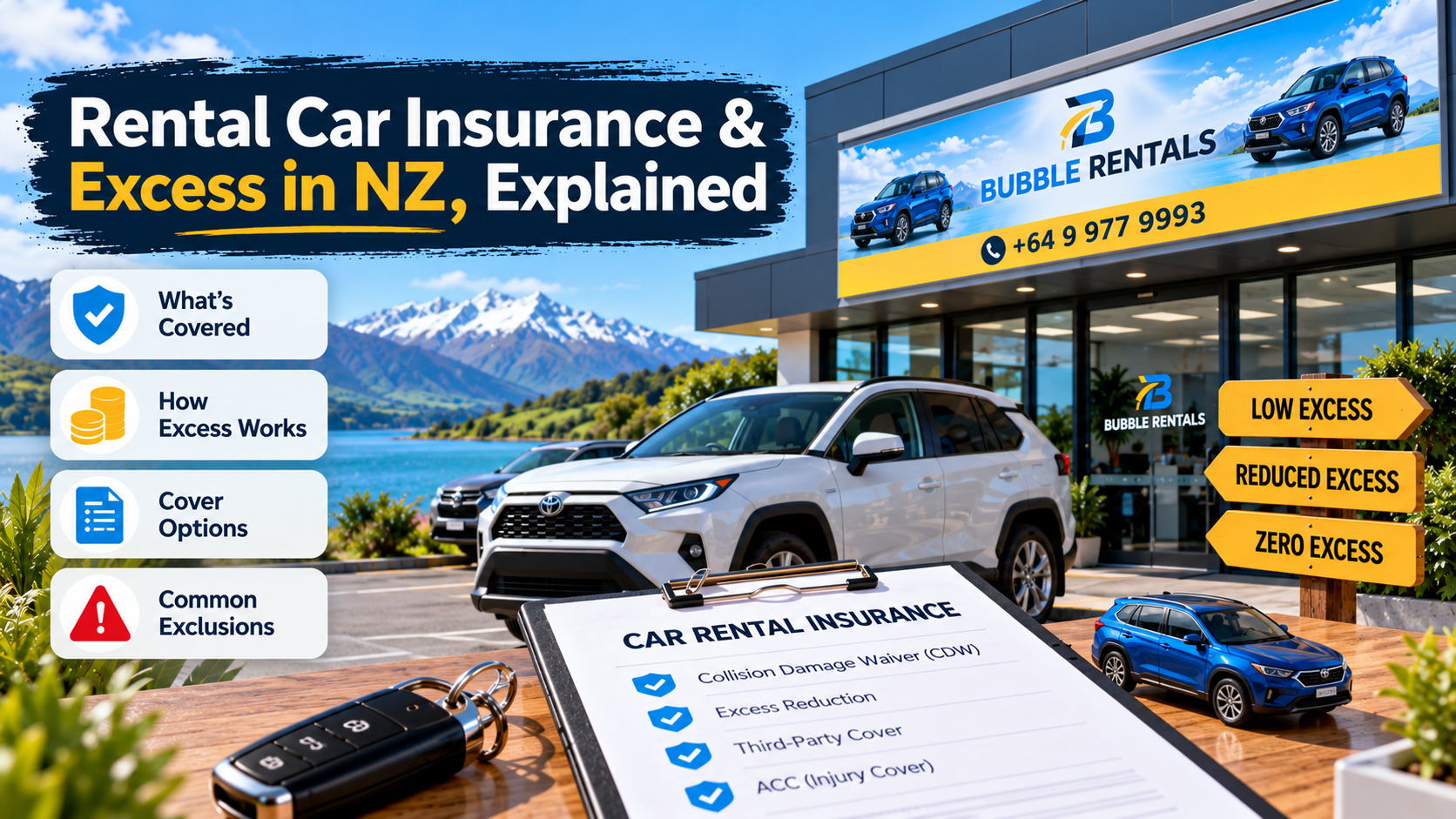
Standard rental car insurance in New Zealand, usually called a collision damage waiver, covers most accidental damage to the vehicle but leaves you responsible for an excess, often $3,000 to $6,000, if damage occurs. Paying for an optional excess reduction lowers that amount, sometimes to zero. Even with full cover, things like windscreen chips, tyre damage, and driving outside the rental agreement's terms are commonly excluded. ACC covers injury costs for anyone hurt in a crash, but it never covers vehicle damage itself.
Rental car insurance is one of those things almost everyone clicks past at the booking stage without really reading, then worries about the moment a stone chips the windscreen on a gravel road or another driver clips a mirror in a car park. This article explains what the cover actually includes, what excess really means for you financially, what's commonly left out even under full cover, and how to think about choosing the right level for your own trip, whether you're booking with Bubble Rentals or anywhere else.
What Rental Car Insurance Actually Covers
Every rental booking in New Zealand comes with some form of insurance included as standard, even if it isn't always described using the word "insurance" directly on the booking page.

Collision Damage Waiver: The Standard Starting Point
The cover included by default is typically a collision damage waiver, often shortened to CDW. In plain terms, it means the rental company won't hold you liable for the full cost of repairing or replacing the vehicle if it's damaged during your rental, provided the damage falls within the terms of the agreement. Instead, your financial responsibility is capped at a set amount, the excess, rather than the full value of the vehicle.
This is the baseline most rentals start from. What differs between providers and booking tiers is how high that capped amount actually is, and that's where the excess conversation begins in earnest.
Understanding the Excess
The excess is the maximum amount you'd be responsible for paying if the vehicle is damaged during your rental, regardless of how the damage happened, as long as it's covered under the agreement at all.
How Excess Relates to Your Cover Level
- A higher excess generally comes with a lower or included daily rate, since you're carrying more of the financial risk yourself.
- A lower excess, arranged through an optional upgrade, usually adds a daily cost to your booking in exchange for reduced personal liability.
- The excess figure is separate from any bond held on your card at pickup, though the two are often related. Our explainer on no-bond rental covers that distinction in full if you want the detail on how the bond mechanism itself works.
The Different Cover Tiers Explained
Most providers offer a small number of insurance tiers, typically building from a basic included level up to a fully reduced excess option.

| Cover Level | Typical Excess | What It Generally Means |
|---|---|---|
| Basic, included as standard | Roughly $3,000 to $6,000 | Highest personal liability if damage occurs, usually the lowest daily rate |
| Reduced excess, optional upgrade | Roughly $500 to $2,000 | Meaningfully lower liability for an added daily cost |
| Fully reduced or zero excess | At or near $0 | Minimal personal liability, highest daily cost of the three tiers |
The exact figures vary by provider and vehicle category, so treat this as a general shape of how the tiers work rather than a fixed quote for any specific booking.
What's Commonly Excluded Even With Full Cover
This is the part that catches people out most often, since "full cover" and "zero excess" don't usually mean every possible outcome is included.
Tyres, Windscreens and Underbody Damage
Tyre punctures, windscreen chips and cracks, and underbody damage from driving on unsuitable surfaces are commonly excluded from standard cover, regardless of which insurance tier you've chosen. Some providers offer a separate add-on specifically for this, worth asking about directly if your route involves gravel or rural roads. Our guide to one-lane bridges and rural driving covers the kind of surfaces where this exclusion becomes genuinely relevant.
Driving Outside the Rental Agreement's Terms
Cover typically only applies when the vehicle is being used within the conditions set out in your agreement.
- Driving on roads or beaches explicitly excluded in your agreement, which some providers specify by name.
- Having an unauthorised, unlisted driver behind the wheel at the time of an incident.
- Driving while affected by alcohol or drugs beyond the legal limit.
- Using the vehicle for a purpose outside normal personal travel, such as commercial transport, without prior agreement.
Any of these can void your cover entirely, leaving you liable for the full cost of damage rather than just the excess, regardless of which tier of insurance you originally paid for.
The Different Names You'll See for the Same Thing
Insurance terminology in car rental isn't standardised across the industry, and the same concept often shows up under several different names depending on which provider you're booking with.
- Collision Damage Waiver, commonly shortened to CDW, is the most widely used term for the standard included cover.
- Loss Damage Waiver, or LDW, is often used interchangeably with CDW, sometimes referring to a slightly broader version that includes theft.
- Super Cover Option (SCO), Premium Cover, or simply "zero excess" all typically describe the upgraded tier that reduces your excess to nil.
- "Excess reduction" is a more literal, plain-English term some providers use instead of a branded product name, describing exactly what it does without the marketing label.
None of these terms are universal, so when comparing two providers, read what each tier actually includes rather than assuming a name means the same thing everywhere.
A Realistic Example: Two Cover Levels Compared
Picture two travellers renting a similar vehicle for a ten-day trip. The first takes the basic, included cover, facing a $5,000 excess if anything happens. Partway through the trip, a minor reversing mishap in a car park scrapes the rear bumper. The repair cost comes to $1,800, well under the excess cap, so they're liable for the full $1,800 themselves, since basic cover doesn't reduce what falls within that excess figure.
The second traveller paid an extra $15 a day, around $150 across the same ten days, for a reduced excess tier bringing their liability down to $500. Facing the same $1,800 repair, they'd only owe $500, with the remaining $1,300 covered under their upgraded policy. In this scenario, the $150 spent on the upgrade saved $1,150 compared to the first traveller's outcome.
This doesn't mean the upgrade is always worth it, and plenty of trips end without a single scrape. A trip that ends without any incident means the first traveller saved $150 and the second traveller didn't need the protection they paid for. The value of the upgrade only becomes clear in hindsight, which is exactly why it's a judgement call based on risk tolerance rather than a fixed right answer that applies the same way to every traveller.
Third-Party Liability and ACC
Insurance isn't only about damage to the vehicle you're driving. It's worth understanding how liability toward other people and other vehicles is handled too.
Rental agreements generally include third-party liability cover for damage you cause to another vehicle or property, within the terms of your policy. For personal injury specifically, New Zealand works differently from many countries through the Accident Compensation Corporation, usually shortened to ACC.
What ACC Covers and What It Doesn't
- ACC provides no-fault injury cover for anyone hurt in an accident in New Zealand, visitors included, covering a share of treatment and related costs regardless of who caused the crash.
- ACC does not cover vehicle damage, lost belongings, or any cost beyond personal injury treatment and support.
- Because of ACC, New Zealand generally doesn't involve the kind of personal injury lawsuits common in some other countries after a vehicle accident, which changes the shape of what your rental insurance actually needs to cover compared to what you might expect from home.
Rental Company Excess Cover vs Your Own Travel Insurance
A genuinely useful question before paying for an excess reduction product is whether you already have overlapping cover through a separate travel insurance policy.

Checking for Overlap Before You Pay Twice
- Many travel insurance policies include a rental vehicle excess benefit, reimbursing you for an excess charge after the fact rather than reducing it upfront.
- If your travel insurance already covers this, paying the rental company's own excess reduction product on top may mean paying for the same protection twice, once upfront and once already included elsewhere.
- The practical difference is timing and process. The rental company's own excess reduction lowers what you're ever charged in the first place. A travel insurance claim means paying the full excess at the time, then claiming it back afterward, which takes longer and requires paperwork you'll need to keep track of while you're meant to be enjoying the rest of your trip.
Reading your travel insurance policy's rental vehicle section before you book is worth the ten minutes it takes, particularly if you're already paying for comprehensive travel cover regardless. Many travellers discover this overlap only after they've already paid for both, by which point there's little to be done beyond noting it for next time.
Credit Card Rental Insurance: What to Know
Some credit cards include rental vehicle excess cover as a cardholder benefit, provided the rental was booked and paid for using that specific card.
- Coverage terms vary significantly between card issuers, so check your specific card's terms rather than assuming a general credit card benefit applies.
- Some card-based cover requires you to decline the rental company's own excess reduction product to remain valid, so read the conditions carefully before assuming you can stack both.
- As with travel insurance, credit card cover typically works as a reimbursement after you've already paid the excess, not as an upfront reduction, so you still need funds available to cover the excess at the time, even if you expect to get it back later.
What Happens If You Need to Make a Claim
Knowing the general process in advance makes an already stressful moment considerably less confusing.
- Report any damage or incident to the rental company as soon as possible, generally required under the terms of your agreement regardless of fault.
- For anything involving another vehicle or injury, contact police as well, particularly if required by law for the type of incident.
- The rental company assesses the damage against your agreement and cover level, charging the applicable excess, or nothing at all if you've taken a zero excess option and the incident falls within its terms.
- If you're claiming through travel insurance or a credit card benefit afterward, keep your rental agreement, any incident report, and proof of the excess payment itself, since these are typically required as supporting documents.
Choosing the Right Cover Level for Your Trip
There's no single right answer here. The right level depends on your own risk tolerance, your route, and what overlapping cover you already have.
- A short, low-risk trip on main roads might not justify paying extra for a reduced excess, particularly if you already have travel insurance that covers the gap.
- A longer trip involving rural or unsealed roads, discussed in more detail in our driving rules guide, carries genuinely higher risk of the kind of minor damage that falls under a standard excess.
- If a $3,000 to $6,000 potential liability would be a genuine financial strain, paying for a reduced excess is a reasonable trade-off for peace of mind, regardless of how statistically likely an incident actually is. There's no wrong answer here, only the one that matches how comfortable you'd feel carrying that risk yourself for the length of your trip.
A Short Checklist Before You Book
- Confirm the exact excess amount under your chosen cover level, not just whether insurance is included.
- Check whether tyres, windscreens and underbody damage are covered or need a separate add-on.
- Review your travel insurance policy for an existing rental excess benefit before paying for the rental company's own upgrade.
- Check your credit card's terms if you're hoping to rely on card-based cover instead.
- Keep your rental agreement and any incident documentation accessible throughout your trip, just in case.
For the practical side of what to bring and check before pickup, our documents checklist covers everything else you'll need alongside your chosen insurance level.
Frequently Asked Questions
What does rental car excess mean in New Zealand?
It's the maximum amount you're financially responsible for if the vehicle is damaged during your rental, regardless of the full repair cost, as long as the damage is covered under your agreement.
Is rental car insurance included by default in New Zealand?
Yes, a basic level of cover, usually a collision damage waiver, is included as standard, though it typically comes with a higher excess than an optional upgraded tier would.
Does rental car insurance cover windscreen or tyre damage?
Often not, even under a reduced or zero excess tier. These are commonly excluded as standard and sometimes available as a separate add-on, worth asking about directly if your route includes gravel or rural roads.
Does ACC cover damage to a rental car?
No. ACC covers personal injury treatment costs for anyone hurt in an accident in New Zealand, regardless of fault, but it never covers vehicle damage or other property.
Should I buy the rental company's excess reduction or rely on my travel insurance?
It depends on whether your travel insurance already includes a rental vehicle excess benefit. If it does, paying for both can mean covering the same risk twice, so checking your policy before booking is worth the time.
Can my credit card cover my rental car excess instead?
Some cards offer this as a benefit if the rental is booked and paid using that card, though terms vary significantly between issuers and often require declining the rental company's own cover to remain valid.
What happens if I decline all optional insurance upgrades?
You remain responsible for the full standard excess amount if damage occurs, generally the highest tier offered, in exchange for not paying any additional daily cost upfront.
Why do different rental companies use different names for the same insurance?
Insurance terminology isn't standardised across the car rental industry. Terms like CDW, LDW, Super Cover and zero excess often describe similar or identical concepts under different branding, so it's worth checking what each tier actually includes rather than comparing names alone.
Is it worth paying extra to reduce my rental car excess?
It depends on your own risk tolerance, your route, and whether you already have overlapping cover through travel insurance or a credit card. A reduced excess only pays off financially if an incident actually happens, so it's a judgement call rather than something with one correct answer.
Want to talk through which cover level actually makes sense for your trip? Bubble Rentals can walk you through the options before you book, so the right level is clear from the start rather than guessed at.